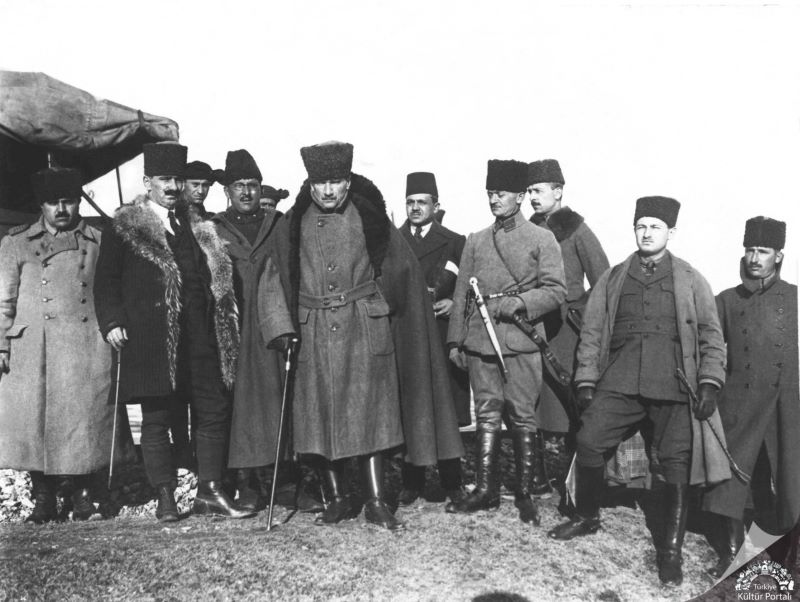
Having conquered vast territories, creating their own homeland from the homelands of other peoples, assimilating or destroying the cultures of conquered peoples, the Turks did not forget their ancestral homeland; they had left their blood kin there. As the ideologue and theoretician of Pan-Turkism, Gokalp, writes: «The land inhabited by a race is called the Homeland; wherever the Turk goes, he does not forget his ancestral homeland, because his ancestors’ graves are there, his childhood years, the paternal hearth, the maternal embrace — all are found there».
Among the Turks, the voice of the race, the call of blood, was speaking. They aspired to unite the territories of all Turkic-speaking peoples into a single state. Pan-Turkism sought to unite the new homelands created in conquered territories and the ancestral homeland into one state, which was called Greater Turan. But considering the strategic problem and the difficulties of creating the state of Greater Turan, Pan-Turkism had set the goal of realising it in two stages:
The first was to consolidate the Oghuz Turks — the Turkmens, who are «the grandsons of Oghuz Khan» and are very close in culture. To this branch belong the Turkmens of Turkey, Azerbaijan, Turkmenistan, and Iran. Then Gokalp continues: «Just like the Turkmens of Turkey, the Turkmens of Azerbaijan, Iran, and the lands of Khwarezm also belong to the Oghuz branch. Therefore, our near goal shall be the Oghuz or Turkmen union; the Oghuz Turks being spread across those four countries, all being close relatives, thus Khwarezm, Iran, Azerbaijan and Turkey, from a Turkish ethnographic viewpoint, are homelands of the same race, and those four countries together can be called Oghuzistan», concludes Gokalp. As we see, to realise Pan-Turkism and to Turkify Turkey, Western Armenia and the Western Armenians were destroyed; then, for the realisation of Oghuzism, Eastern Armenia also had to be destroyed, as it was an obstacle on the path of uniting those countries.
The ideologues of Pan-Turkism, even during the First World War, had great hopes that the Russian Empire would collapse and their national ideal — Pan-Turkism — would become a reality. They carried out extensive activity to realise their programmes, particularly to occupy Transcaucasia and destroy the Eastern Armenians. If Turkism was realised by the force of Turkey, then in the work of creating the Oghuz state, a share fell to Turkey and Azerbaijan. To that end, Turkey and Azerbaijan, on 29 November 1919 and 15 April 1920, signed a secret agreement against Armenia. On 28 September 1920, Turkey attacked Armenia, and on 29 November of the same year, Russian troops entered Armenia.
The Republic of Armenia became the victim of Turkey, Russia and Azerbaijan. Armenia’s independent statehood was destroyed and Armenia was partitioned: Turkey occupied Western Armenia, Kars, Surmalu, with Mount Ararat. Eastern Armenia and Azerbaijan passed to Russia. Azerbaijan passed to Russia according to the terms of Mustafa Kemal’s letter to Lenin of 26 April 1920, and as compensation, Nakhichevan and Karabakh were given to Azerbaijan. This was a great victory for the Pan-Turkists, but the Oghuz state was not created.
The distant goal.-
What does Turanism mean? The Pan-Turkists clearly delimit the concepts of Turk and Turan. Gokalp says the following: «To understand the differences between Turkishness and Turanism, it is necessary to determine the boundaries of the Turk and Turan groups. Turk is the name of a nation. A group that has its own distinct culture is called a nation. Therefore, the Turk can have only one language and one culture». As we saw, Gokalp includes the Azerbaijanis and Turkmens in this group.
According to the Pan-Turkists, the homeland of the Turks is a vast territory encompassing from the Balkans and Hungary to Manchuria, and from China to the Arctic Ocean. Then Gokalp adds: «And since Turk is the name of a nation, then for the union of all Turkic-speaking peoples living in the aforementioned territories, the need for a new name shall be felt, and behold, that general name is called Turan». Gokalp continues his speech: «Turan is the great homeland of all Turks, realisable in the past and the future; Turan is the collective name of the territory inhabited by Turks; we must call Turan the great Turkestan containing all Turkish branches».
The distant goal of Pan-Turkism is the consolidation of Turkic-speaking peoples under the name Turan, the creation of the state of Greater Turan. The Pan-Turkists understood that the idea of Turanism could not be realised easily. Gokalp writes the following: «Uniting hundreds of millions of Turks into one nation is a strong source of aspiration for the supporters of Turkism. If the idea of Turan did not exist, Turkism could not have spread so quickly, but perhaps, in the future, the realisation of the Turan idea will be possible. The idea is to create independence. Yesterday, for the Turks, the national state was an unrealisable idea, while today that idea has become a reality in Turkey».
Another ideologue of Pan-Turkism, Mehmet Emin, says the following about Greater Turan:
«All the bees have one hive,
all the Turks must have one Turan».
Then Emin calls on all Turkish peoples to unite around the idea of Greater Turan, warning that «without blood no flower is born; without sacrifice, without the destruction of other peoples, no homeland is created».
If the aforementioned two authors were calling on the Turkish peoples to unite and create one unified homeland — Greater Turan — then another ideologue of Pan-Turkism, Enis Avni, already openly sets forth the programme of destroying the peoples lying on that path:
«From every part of the ground we tread, blood shall gush forth
Under my outstretched paw, springs shall turn to autumn and autumns to winter…
If I leave stone upon stone, may the hearth I leave behind be destroyed…
With my sword I shall turn the rose gardens into graveyards…
I shall leave to history such a ruined and razed
Wreck, that for ten centuries people will not be able
To build civilisation upon it».
Thus, if through the realisation of the ideology of Turkism the Western Armenians were destroyed, then through the realisation of the ideology of Pan-Turkism, the Eastern Armenians also had to be inevitably destroyed.
Turkey, regardless of who has been at the helm of power, has consistently fought to realise the programme of Pan-Turkism, and continues to do so to this day.
This is the fundamental and important lesson of history for the Armenian people. If, on the one hand, the realisation of Greater Turan threatens to destroy our people and our independent statehood, then, on the other hand, it threatens to partition Russia, separating from it the territories inhabited by Turkic-speaking peoples. To withstand Pan-Turkism and to be saved from a second genocide, history has left our people one path: an alliance with Russia.
Kevork Halebleyan