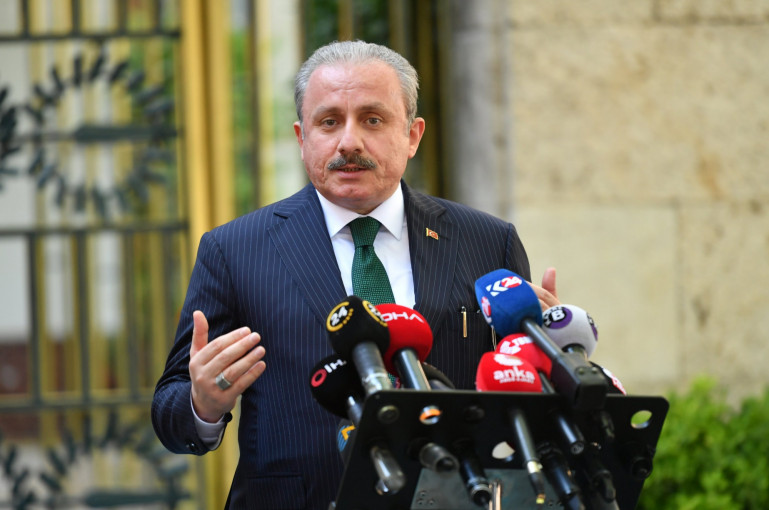
A century after the signing of the document, the Treaty of Moscow has not lost its significance. This was stated by the Speaker of Turkey’s parliament, Mustafa Şentop, as reported by the Anadolu Agency.
The Speaker of the parliament spoke at the opening of discussions on “Relations between Turkey and Russia on the centenary of the signing of the Treaty of Moscow of 16 March 1921,” organised in the building of Turkey’s parliament.
“This document became the testimony of Russia’s recognition of the government of Turkey’s parliament and the determination of our country’s eastern borders. The treaty was signed a year after the establishment of diplomatic relations. Thus, the two countries demonstrated their desire for solidarity and mutual support,” said Şentop.
The Russo-Turkish Treaty of Moscow — the “Treaty of Brotherhood and Friendship” signed on 16 March 1921 between the government of the Russian Soviet Federative Socialist Republic (RSFSR) and the government of the Grand National Assembly of Turkey — was negotiated during the second Russo-Turkish conference in Moscow (26 February – 16 March 1921).
By this treaty, Russia recognised Turkey’s sovereignty over all territories recognised as Turkish by the National Pact. Turkey, for its part, relinquished Batum, receiving in exchange the Surmalu district. The treaty established Turkey’s north-eastern border, which remains in force to this day.
The second Russo-Turkish conference in Moscow was held from 26 February to 16 March 1921, with the aim of regulating relations between Kemalist Turkey and the Soviet republics.
At the conference, the RSFSR was represented by Georgi Chicherin and Celal Korkmazov, and the government of the Grand National Assembly of Turkey by Yusuf Kemal Bey, Rıza Nur Bey and Ali Fuat Pasha. Thanks to the efforts of Stalin, then Commissar for Nationalities, Chicherin definitively abandoned his previously pro-Armenian stance. On the question of Armenia’s borders, Chicherin declared that they would not insist on drawing the border west of the Arpachay and south of the Araks. This meant that not only the entire Kars province but also the Surmalu district, which had never been part of Turkey, would pass to Turkey. However, the Turkish delegation was not satisfied with this and demanded that the Nakhichevan region not remain with Armenia but be placed under the patronage of Azerbaijan, which in turn would be obliged not to cede that patronage to a third state in the future — that is, to Armenia.