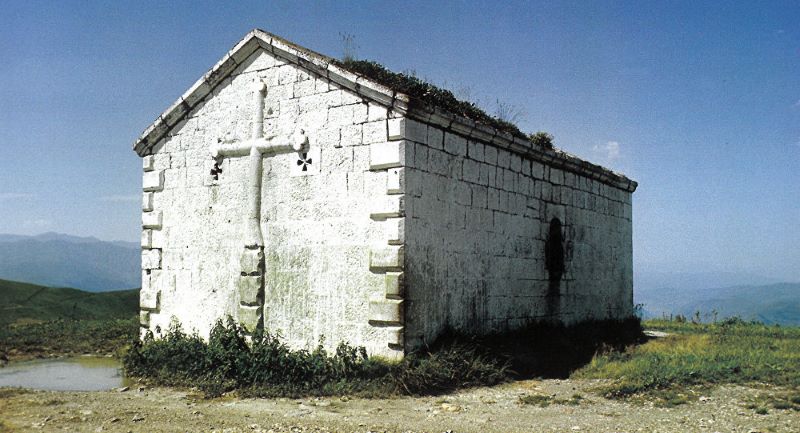
One of the Azerbaijani media outlets has once again attempted to present the Armenian chapel of Pandalion in the Shahumyan region of the Nagorno-Karabakh Republic, which is under the control of the Azerbaijani armed forces, as Albanian.
In particular, the publication Oxu.az wrote that “the Albanian church located on the Javadkhan height of the Yeni Zod village of the Goygol district is on the verge of destruction.”
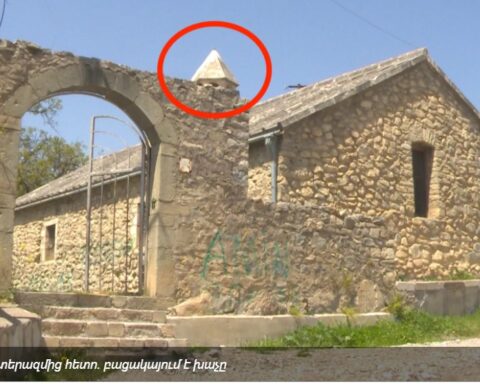
Numerous photographs were attached to the report about the “Albanian” church (which, for well-known reasons, has no name). For example, these.

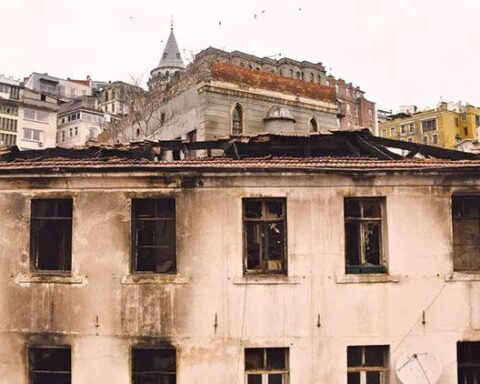
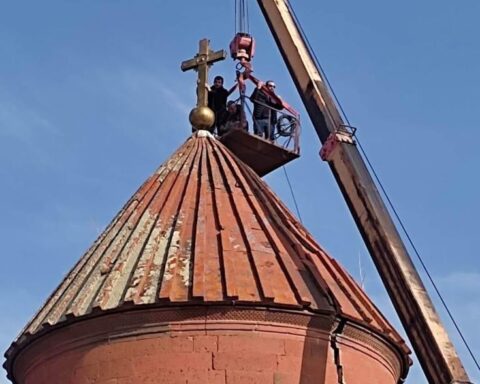
The Armenian chapel of Pandalion in the Shahumyan region of the NKR

The Armenian chapel of Pandalion in the Shahumyan region of the NKR
Of greater interest is the photograph of the stone with an inscription in front of the church (which the Azerbaijani media have called Albanian).
For anyone who knows Armenian, reading that inscription is not difficult. If we turn the “Albanian” inscription around, it immediately becomes Armenian.

The stone with an Armenian inscription placed near the Armenian chapel of Pandalion
“Hayk. G” — Hayk is one of the most common Armenian personal names (which, according to various interpretations, means “Armenia,” in ancient Armenian “Armenians,” and the root is also used in the name Hayastan).
In reality, it is the Armenian chapel of Pandalion (Pandavank) in the village of Azat in the Shahumyan region of the NKR, occupied by Azerbaijan (the Azerbaijanis have renamed the village “Yeni Zod”).

The stone with an Armenian inscription placed near the Armenian chapel of Pandalion
On the website of the foundation studying Armenian architecture, for example, one can find photographs of this church, founded in 1856.
And this photograph, taken in 1985 by Samvel Karapetyan, a connoisseur of Armenian architecture and history, needs to be looked at more carefully.

The Armenian chapel of the village of Azat in the Shahumyan region of the NKR
On the facade of the Armenian chapel, dated 1896, there was once an inscription about its reconstruction (“The chapel of Saint Pandalion was reconstructed in 1956…”). And next to it (on the left) is the stone with the word “Hayk” that we already know.
The old inscription, of course, is no longer there; it has been “torn off” from the facade. In the Azerbaijani photographs, there is an empty rectangle above the entrance to the chapel.

The Armenian chapel of the village of Azat in the Shahumyan region of the NKR
Incidentally, this is not the first unsuccessful attempt to present this chapel as Albanian. Earlier, during the broadcast of the “Yol” programme on Baku television, while presenting a video piece about the supposedly Albanian church, the journalist, in a contemptuous manner, stepped on the aforementioned inscription lying in front of the half-ruined chapel.
It should be noted that for the Armenians living in those parts, the chapel of the village of Azat enjoyed great reverence. It was also a place of pilgrimage.
According to 1988 data, the village’s population was 550. The residents were engaged in animal husbandry and horticulture. The village had a secondary school, a house of culture, and a hospital. There was a stone church in the village (13th century), not far away — the Church of St. John the Baptist, the Pandalion chapel (19th century), and to the west — the ruins of a monastery. In 1990, with the help of the USSR Ministry of Internal Affairs troops, Azerbaijani united special-purpose detachments seized the village. The residents were displaced, and most of them settled in Armenia.