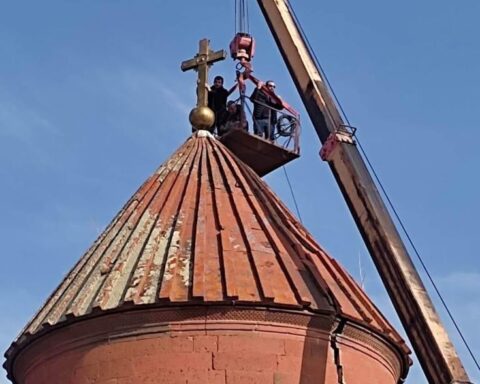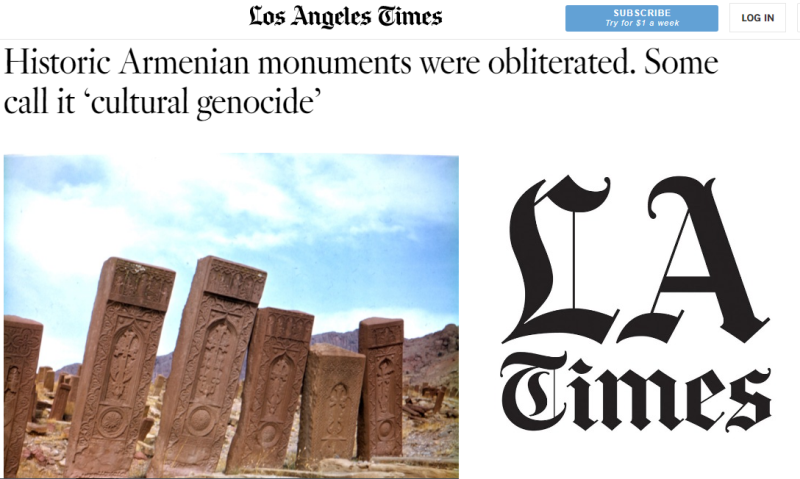
For centuries, the holy khachkars of Julfa — the massive, richly ornamented memorial stones of the 16th century — stood on the banks of the Arax, jealously guarding the world’s largest medieval Armenian cemetery. Earthquakes, wars and vandalism thinned their ranks, but by the mid-20th century thousands of khachkars were still standing, writes the LATimes.
Today, however, there is not a single khachkar in Julfa, in Azerbaijan’s remote Nakhijevan region. Despite UNESCO’s 2000 recommendation regarding their protection, testimonies published this year in Hyperallergic magazine showed that the monuments were secretly and systematically destroyed, within the framework of Azerbaijan’s policy of eradicating Armenian cultural heritage in Nakhijevan.
The article notes that the scale of the destruction is staggering: 89 medieval churches, 5,840 khachkars and 22,000 tomb stones. Simon Maghakyan, 33, co-author of the cited article, called the destruction of churches and monuments in Azerbaijan between 1997 and 2006 a “cultural genocide of the 21st century.”
According to activists, satellite photographs from 2003 and 2009 bear witness to the destruction of the world’s largest medieval Armenian cemetery in Julfa.
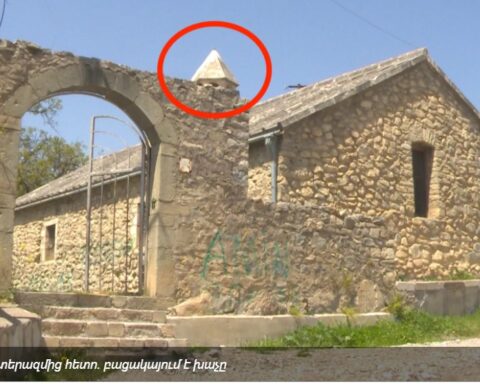
Maghakyan shows slides of “before and after” photographs, satellite images, Azerbaijani archival documents and video recordings — evidence of the destruction of Armenian holy sites by the Azerbaijani army.
Unlike the “Islamic State” and the Taliban, which have contributed to the destruction of historical ruins and monuments, Azerbaijani officials deny that the Armenian cemeteries and churches in question ever existed.
“That is worse than what the ‘Islamic State’ was doing,” said Maghakyan. “How could the world ignore this? How did Azerbaijan go unpunished? And if I do not tell this story, then who will? I would never forgive myself if the world did not learn about the greatest cultural genocide of our times.”
Nakhijevan is an isolated region controlled by Azerbaijan but separated from the rest of the country, surrounded by Armenia, Iran and Turkey. The historically Armenian territory of Nakhijevan is today inhabited mostly by Azerbaijani Turks. Maghakyan described it as the “North Korea of the former Soviet Union,” closely watched and strictly controlled. In particular, Julfa is difficult to access, located along the southern militarized border between Nakhijevan and Iran.
About 20 khachkars removed from Julfa during the Soviet years are preserved in museum collections around the world, including the Metropolitan Museum of Art in New York (the museum included khachkars in its notable “Armenia” exhibition last year).
Maghakyan is not only tirelessly disseminating information about this cultural loss; he is now urging the UN Security Council to launch an investigation into Azerbaijan’s actions in Nakhijevan.
According to him, his main goal is simply to force the world to bear witness to a case of cultural genocide.