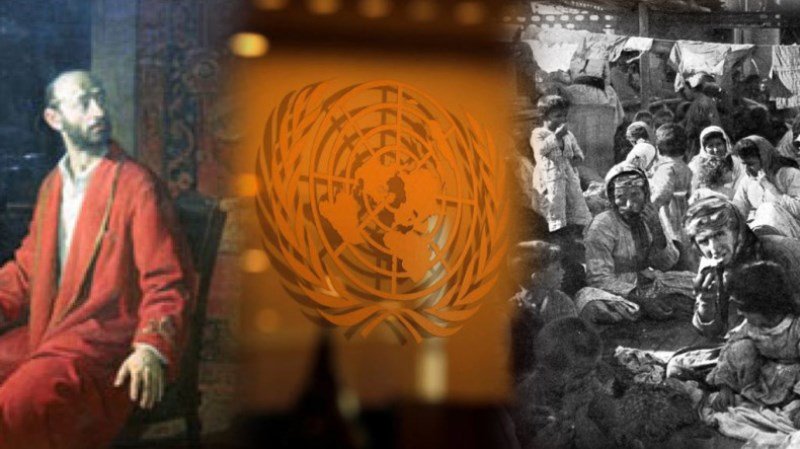
The conference dedicated to the prevention of genocides and education, initiated by Armenia’s mission at the UN office in New York, began with the music of Komitas. This is reported by the Voice of America.
Armenia’s representative to the UN, Mher Margaryan, emphasized: “The Armenian nation went through the horrors of the Genocide at the beginning of the 20th century, therefore, Armenia has a special obligation to unite efforts to prevent the crime of genocide.”
Events precede the implementation of genocide, during which the rights and fundamental freedoms of a country’s vulnerable groups come under pressure, Margaryan noted.
The director of the Global Centre for the Responsibility to Protect, Simon Adams, who moderated the conference, addressed the example of the Armenian Genocide, reminding that in four months the 105th anniversary will be marked, when “on April 24, 1915, the targeted killings of Armenians began in the Ottoman Empire.”
“As a result of these actions, more than one and a half million lives were destroyed. The United Kingdom, France, and Russia in May 1915 accused the Ottoman Empire of committing a crime against humanity—that was the first time the term was used in an attempt to characterise the scale of the atrocities.”
According to scholars and psychologists, the denial of genocide is not only an insult to the victims of genocide, but also paves the way for the next genocide.
“When my students read the works of Ron Suny, they are truly horrified, shocked, and amazed by the level of violence that the Armenian community of the Ottoman Empire went through, and they demand an explanation,” noted Eric Weitz, professor of history at the City College of New York.
A staff member of Turkey’s mission to the UN, present at the conference, upon hearing all this, requested the right to speak, declaring that the last years of the First World War were a difficult period for the Ottoman Empire, during which all citizens of the empire suffered.
“It is humanity’s duty to establish that Armenians suffered exactly as much as the other citizens of the Ottoman Empire, and expressing different opinions in Turkey regarding the events of 1915 is part of the culture of democracy. However, using the events of 1915 as a pretext for expressing hostility towards Turkey and turning this issue into a matter of political conflict is unacceptable.”
International law does not recognise the events of 1915 as genocide, concluded Turkey’s representative.
In response, Henry Theriault, head of the International Association of Genocide Scholars, noted that today, taking into account all the research, even discussing the denial of the Armenian Genocide is meaningless.
“In the last 50 years, I had not heard such a direct denial of the Armenian Genocide. Thank you for demonstrating it so vividly. However, I would advise you to update your literature, as it is outdated by about 30 years. The arguments you have brought have been refuted many times and long ago, so I would urge you to do a little work so that what you say has substance. Let me also say that many people in Turkey—educated, developed ones—have fully recognised the Armenian Genocide, but contrary to your statement, many of them are currently in prison or have previously been imprisoned for recognising it.”