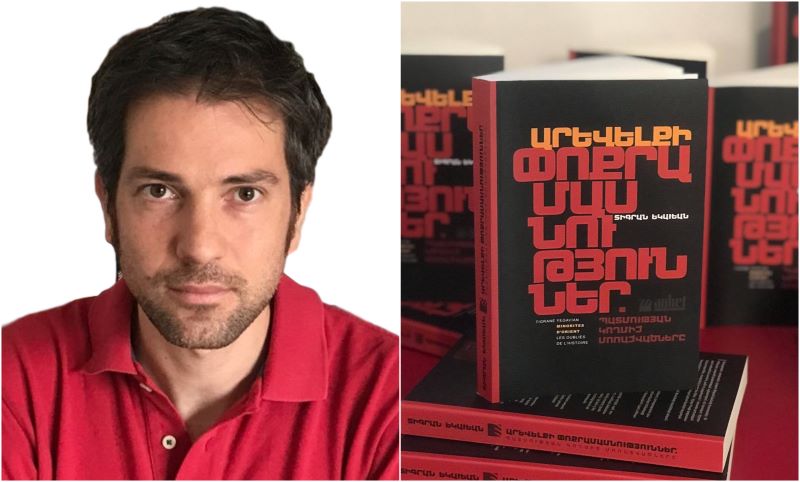
On Friday, 23 July 2021, the launch of the Armenian translation of journalist, independent researcher and Arabist Tigran Yekavyan’s book “Minorities of the East: The Forgotten by History” took place in the hall of the Avetik Isahakyan Central Library in Yerevan.
It should be noted that the book was translated from French. The French version of the book received a very wide response and was also awarded a special prize by the “Mission of the East” public organisation. It was translated into Armenian by writer Krikor Janigyan and edited by historian Kevork Yazıcıyan.
Yazıcıyan, who moderated the event, giving his assessment of the work, noted that the book is a scientifically grounded study of the problems of the indigenous peoples of the Middle East — Christians and also Yazidis — and of the West’s indifference towards them, as well as a concern and alarm regarding the end of Western civilisation.
The editor also highly praised the author’s courage, who, living in Paris, without the slightest reservation, proved with facts in his book how the French, acting out of their own interests, exploited the sentiments of the minorities of the East and especially of the Christians, subsequently leaving them to the whims of fate.
The two main speakers of the event, in turn, presented the book with deep analytical and documentary reflections:
The first speaker, candidate of historical sciences Araks Pashayan, noting that the book is based on three main narratives, presented each of them in a comprehensive and substantive manner.
According to the narratives identified by Pashayan, in one of them the author presents the entire transformation of the political, social and cultural upheavals related to the minorities of the Middle East — Christians, mainly Assyrians and those of Aramaic origin, and Armenians — over the course of about 100 years, showing the most pivotal events that had a negative impact and led to the departure of minorities, including non-Christians, from the region: first the collapse of the Ottoman Empire, then the Arab-Israeli conflict, the policy pursued towards minorities during the period of Gamal Abdel Nasser, the Islamic Revolution in Iran, the Lebanese civil war, the crisis in the Gulf countries, and finally the developments related to the US invasion of Iraq in 2003 and the events of the Arab Spring. Pashayan emphasised that here the author has also singled out global economic and geopolitical factors, and has addressed the problems in a targeted manner, separating the problems of minorities in each period.
In the second narrative, the author shows that the emigration of Middle Eastern Christians and their departure to the West formed another parallel reality of the minorities, which the author calls diasporaisation, and shows how, in the new transnational environment, processes of identity transformation begin among the minorities, and even phenomena of national renaissance. And finally, in the third narrative, the author tries to apportion responsibility as to who, in the end, is to blame for the security problems and emigration of the Christians of the Middle East, and the author holds responsible both the West and the minorities, who in the last years of the Ottoman Empire in many cases could not take the right side and showed political immaturity, and the Arab governments, which could not create a security environment where the freedoms of minorities would be protected.
Pashayan noted that throughout the book, like a red thread, runs the idea that the creators of the uniqueness of the Middle East were the minorities, without whom the Middle East would lose its role and significance, and thus the author proves that today keeping the Christian community is not an end in itself; they had a very serious civilisational role as a bridge between the West and the East, as well as in strengthening social solidarity, and they also played a great role in the formation of a multicultural environment in the Middle East. And the author’s final message, according to Pashayan, is addressed to the West in general, where he has posed a very important question, asking whether the West, no longer being a civilisational platform carrying the Christian reality, is capable of taking that burden upon itself.
At the end of his speech, Pashayan noted that Tigran’s work is a fairly valuable study also in terms of source material, where very important sources and data of documentary significance have been used.
The second speaker of the day was the book’s translator, writer Krikor Janigyan, who in turn considered the birth of the book’s Armenian version a significant and exceptional phenomenon in Armenian reality. Janigyan, who, as the book’s editor also testified, has made a magnificent translation, characterising in one word what this book is about, said that it is a cry of alarm, an alarm signal, about the fact that today all the holy places of Christians are under the tyranny of Muslims, and all Christian territories are becoming the Islamic world.
Janigyan noted that now the minorities of the Middle East are as powerless and unprotected as the Armenians were in 1915. In this regard, he pointed out that Tigran Yekavyan’s book has a great generalisation, where the author poses the question: if in 1915 the civilised Christian world had stood in defence of the Armenian cause, of Christianity, not formally but truly, would these religious and cultural genocides have continued?
Speeches were also made by Iranologist, orientalist, translator and regional affairs expert Emma Begijanyan and philologist, Armenologist, writer and lexicographer Artsvi Bakhchinyan, who qualified the book with its historiographical and political science characteristics as a unique and exceptional, high-value and highly topical phenomenon, stressing the urgency of its multilingual translation in the near future.
Hasmik Karapetyan, director of the “Avetik Isahakyan Central Library” SNCO and Honoured Cultural Worker of the Republic of Armenia, in her words of congratulations and high appreciation, stressed the book’s undeniable role in strengthening the national consciousness of the library’s thousands of young readers and of Armenian generations in general, and in the formation of true civic behaviour. She expressed her readiness for the urgent popularisation of the book.
The book’s editor Kevork Yazıcıyan, noting that he had received great pleasure in doing this work, also considered the fact that it is the result of the collective united work of the author, translator, editor and publisher as a factor in the book’s success. He noted that references and footnotes have been added to the Armenian book, as well as indexes of names and place names, considered very important for researchers, which have increased the book’s scholarly value.
The book’s author Tigran Yekavyan delivered the closing speech, trying to answer two questions: why this book and why translate it into Armenian. Answering the first question, he saw the purpose of the book’s publication, in light of the situation created in the Middle East, especially in Iraq and Syria, as addressing the issue of minorities from a non-emotional but realistic perspective and refuting many ideas that are widespread in French society regarding this issue, noting that the French leadership made many mistakes in its Syrian policy, the effects of which continue to this day, and therefore it was necessary to gather the geopolitical and critical experience and present it to the general public. As for the second — why Armenian — he noted that we forget a very important thing: the valorisation of Armenian statehood, noting that no matter how vulnerable and limited in power a state Armenia is today, it also, as the homeland of all Armenians, has a historical responsibility for the protection of Christian and Yazidi communities before international forums. He stressed that this idea of his is not an emotional observation but a very serious diplomatic issue, and this is the main purpose of the book’s translation: to give a message that we become aware of the role we have and accept that we must defend this cause, in the name of the protection of human rights and human dignity.
He particularly emphasised the devotion and mission of every Armenian in the work of preserving and protecting the statehood of all Armenians, especially stressing the need to develop a more realistic, non-romantic national worldview.
Tigran Yekavyan in conclusion conveyed his words of gratitude to the editorial staff, the library’s director, and all supporters and participants.
Special correspondence for “Ramgavar Mamoul”