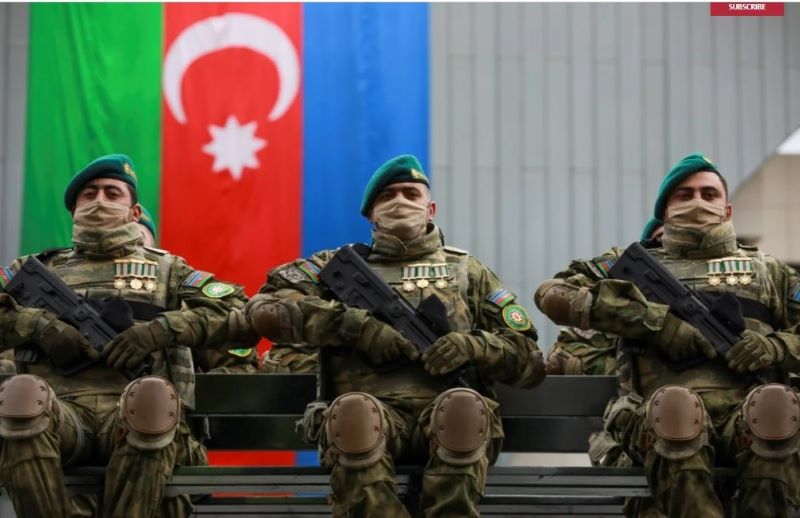
Michael Rubin, a scholar and analyst at the American Enterprise Institute, has commented on the “Victory” parade held in Baku on 10 December, suggesting that Aliev has celebrated a short-term victory. He also analyzed the consequences of the latest Artsakh war for both Armenia and Azerbaijan. The author noted that Aliev has not yet understood what price he is paying for this victory.
“He still does not realize the enormous price of his victory — Azerbaijan’s sovereignty. Russia and Turkey have deployed their forces on Azerbaijan’s territory. Turkey also commands several thousand mercenaries it has transferred to Azerbaijan from Syria, Libya and other Arab countries. None of these forces are under Aliev’s control. Both Moscow and Ankara can easily turn them against Aliev and his family if he tries to deviate too far from Erdogan’s or Putin’s dictates,” reads the analyst’s article, published in The National Interest magazine.
As he observed, “Aliev can focus on Nagorno-Karabakh, but for Putin this game is much bigger and extends his dominance in the Caucasus, if not beyond its borders.” “This is not an expansion of territories, but of the nature of governance. In the latest Caucasian war, Putin has again won, signaling to the region that Russian autocracy offers security, while liberal democracy brings only chaos and territorial losses,” the author wrote.
Rubin noted that neither the Trump nor the Obama administrations paid the necessary attention to the Caucasus. “Their strategic indifference was a failure — not only because of the region’s strategic importance, but also because of its cultural value. In 301 AD, the Kingdom of Armenia adopted Christianity, declaring it the first state religion and becoming the oldest Christian country in the world,” the author noted.
He added that all three states of the South Caucasus have already experienced democratic revolutions.
“…Armenia, which is perhaps culturally the closest country to Russia, has followed the same path. Former journalist Nikol Pashinyan came to power in 2018 thanks to mass protests… Pashinyan largely sought to demonstrate neutrality on foreign policy matters. Yet he did nothing to challenge Russia’s influence in Armenia,” the analyst observed.
“Armenians may be disappointed that Russia did not do much to defend them against Azerbaijan and Turkey in the latest Nagorno-Karabakh war, but in hindsight it can be stated that defending Armenia and especially the unrecognized republic of Artsakh was secondary compared to the lesson the Kremlin had already taught Azerbaijan and Georgia: that democratic revolutions can bring short-term political freedom, but they also lead to territorial losses and the destruction of sovereignty,” Rubin concluded.
Let us recall that Nikol Pashinyan signed a trilateral statement on 10 November, under which the seven districts of Artsakh, Shushi and Hadrut pass to Azerbaijan, with the exception of one village, villages from the Askeran and Martuni districts, as well as the Talish and Mataghis villages of the Martakert district.
According to that statement, a peacekeeping contingent of the Russian Federation will be deployed along the line of contact in Nagorno-Karabakh and along the Lachin corridor, including 1,960 servicemen armed with small arms, 90 armored vehicles, 380 units of armored vehicles and special equipment.