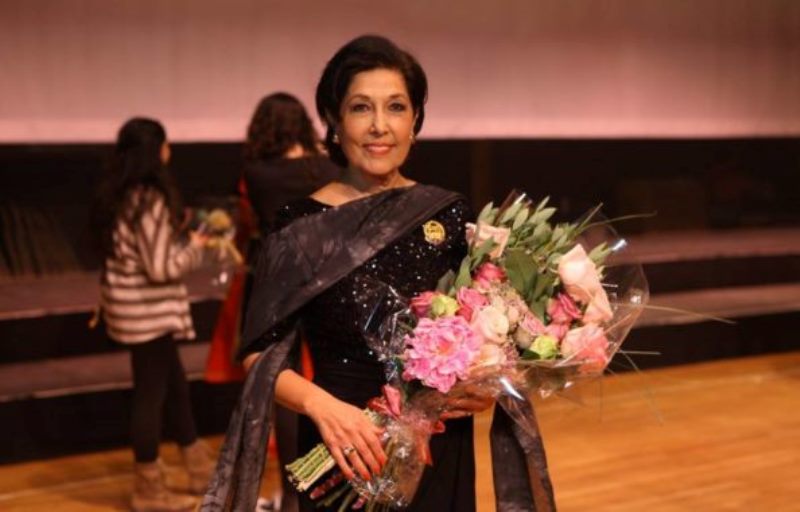
Seda Paskalian-Gantarchian, artistic director and dance instructor of the “Shushi” dance group of New York, answers our questions.
-How did you enter this profession? If you give a brief history, what can you single out from your activity, which has had a continuous course to this day?
-Our family has not been far from the field of dance; I am the sister of Sarkis Paskalian, who was the leader of a professional Armenian group in Lebanon. I always watched my brother’s dances and loved dance. My older sister was also a dancer and still teaches dance at the AGBU club in Montreal. Among us, there has always been love and special attention towards the Armenian art of dance.
-How old is the “Shushi” dance group you founded?
-“Shushi” has already completed its 27th year since its founding, and in the coming days, in September, the 28th year of our dance group’s activity will begin. I can honestly say that a fairly strong group has emerged, very well received and known in all circles. It is true that our dance group operates under the auspices of St. Vartan Cathedral, but it is materially completely independent… It is independent in every sense. We cover the group’s material needs through the annual membership fees of our members, the dancers. And the secret of our success is that none of us, none of the members of our committee, does this work with material expectations; we are all devoted. I, for example, worked for 29 years in a completely different field—cosmetics (aesthetics)—and after that at “LG Electronics,” the world-renowned company, which has nothing to do with the atmosphere of art. I approached the art of dance as a devotion; as much work as was required, I did it, only so that we would present ourselves at a high level… On the path of presenting the best, we traveled quite a long way and tried to offer the best in everything for the Armenian, and why not, also for the foreign community. To give an example, I should note that our group’s costumes are made in Yerevan, and currently we have about three thousand dresses in our “wardrobe.” We have spared nothing for our group and its success; we have not thought about securing profits from concerts, because for us the most important thing is to perform at a high level, so that our children feel proud at the end of the concert—proud that they performed, proud that they danced well, and ultimately proud that they are Armenian.
-And from what environment do the dancers come?
-I can say that we have dancers from every community, every circle, every union; there is no discrimination among us. Parents know that the dance group has no partisan coloring, even though I am Ramgavar by roots, but such matters never arise among us. I absolutely do not want to give it a political coloring, because my mission is not to bring people to a party, but to serve our Armenian culture. I think this has been the main reason for our success; when they say, “The ‘Shushi’ dance group has a concert,” everyone comes, because it belongs to everyone.
-The name is interesting. How did you conceive it, why “Shushi”?
-When we started our activity, I never thought that we would reach this point, that we would enjoy such fame. One of our current dancers, Ani Sedrakyan, asked me to teach her and three of her friends to dance, so that they could dance during a memorial ceremony at their school. At first I thought that in one week, with four beginner dancers, it would be very difficult to produce something good, but I did not want to refuse, and I taught them. Later, it was written about in a community newspaper, and on that basis an invitation came to us from Philadelphia. I thought that participating in a concert with four girls would be difficult; at least the group should become seven or eight… And so we prepared four dances, and to enrich our presentation, we invited Vartan Abdon, the founding director of the Armenian radio hour of New Jersey, so that he too would speak about Armenian culture; we also asked the Hovnanian School choir to participate, and in that way we put together a complete program. Then everyone said that this work should continue, and so we grew little by little: 12 became 20, then 40, and after a certain period the number of our group’s members reached 137—something we truly thought impossible. And as for why we named the group “Shushi,” that too is conditioned by our close ties with Karabakh. We had formed a union whose purpose was to support Karabakh, and with all the means we had, we tried to extend a helping hand to Karabakh and its people. Later, in New York, we hosted as guests Artur Aleksanyan, one of the participants in the Karabakh war, and Seyran Ohanyan, the former Minister of Defense of Armenia. They took part in our performances, during which there was a special dance dedicated to the struggle of Karabakh, through which we tried to tell the audience about the path Karabakh had traversed. What was presented was a huge work, and that is why we decided to call the dance group “Shushi”… At that time everyone was delighted, and after that, on two different occasions, the dance group reached Shushi and performed there with two performances—in 2005 and 2015. Our performance on the occasion of the centennial of the Great Genocide was presented to the music of Ara Gevorgyan’s “Remember.” Ara was also invited, and after seeing the performance he said, “Dear Seda, it was a very moving performance; I congratulate you…”
In general, yes, joyful dances are important to us, they are needed, but for me, dances that convey a message are also important.
-Do you decide the program of dances? In what way do you conceive the dance repertoire?
-Generally, the theme is what matters to me. When I am preparing a performance, there must be a theme, so that you say something to the people. For example, this last concert we had in Gyumri was dedicated to Komitas Vardapet, and the one before that to April 24. That is to say, I mean that we prepare special performances for every occasion, of course with the aim of tying the audience with a thread to our people, land, and history. Ultimately, it is very important to me that when the people leave the hall, besides the dance, a general picture is imprinted on their hearts and souls.
-In our times, the world moves in different directions; you have chosen the language of culture, the weapon of culture. In New York you have created a cultural hearth—is it an effective weapon, since in the present century culture is influential?
-I think culture is the most powerful. Today, thanks to our dance group, children who do not know how to speak Armenian well on foreign shores listen to Armenian music, and the little ones, who come to rehearsal several times a week, learn Armenian music and song; therefore, song and dance are not forgotten… Many parents have said, “They would not listen to Armenian at home; now, as soon as the little ones get in the car, they say, ‘Put on the Shushi songs.'” When I choose my songs for a performance, I do not leave it to chance, because, ultimately, it must speak to the hearts of the people and the dancers.
-Do you also present foreign dances?
-Absolutely not, because they already exist everywhere. Only when we visit a country, as a sign of respect, do we sometimes prepare one of their dances. For example, when we performed in Lebanon, we also presented an Arab dance; in Moscow, a Moldovan one.
-And what is the attitude of foreigners? Are Americans present at your concerts?
-I can say that wherever we have traveled, we have had quite a number of foreign spectators—Russians, Arabs, Spaniards, and others. And in our city (meaning New York), generally the dancers invite their American friends, who always tell my dancers, “Why do you go to dance class? Let’s go somewhere else for entertainment together.” But when they come and see the performance, they are amazed. On one occasion, during the period I worked at “LG Electronics,” I had invited the president of the company, who is Korean, to our performance. He came, and after watching the performance, he bought four or five video discs of our previous performances and said, “I cannot believe that Seda, with such a heavy job, can prepare such a performance…”
-As far as I understood, you often come to Armenia.
-This visit of mine is already the tenth. I first came in 2001; afterwards, when costumes were needed for the dance group, my visits became more frequent. We have our costumes made in Armenia, because in America that is a difficult matter. Of course, there is also the question of providing work for Armenian designers and tailors.
-How did you see Armenia this time? What changes did you notice? What can you say about that…?
-If I am honest, I heard various positive and negative things, not about the change that took place, but about Armenia’s current situation. Generally, when I get into a taxi, I ask the drivers what their feeling is, what they think. One says, “I am very satisfied,” another says, “Nothing has changed.” Today, in the diaspora, we too are in a state of confusion; many appreciate what has happened, many do not. Of course, only one year has passed since the change of government, and we cannot expect everything to change quickly. But if we look at the general picture, there is progress. In 2001, when I first came to Armenia, there were barely ten lighting poles in the square; now our beautiful square is entirely illuminated and very attractive. On every occasion I notice that new buildings and hotels are rising. The same is the case in Karabakh. When we went in 2015 and had a concert in the square on the occasion of the centennial, I felt a different enthusiasm, because on our first visit the picture was very sad, while on the second I was left happy, and my dancers also got a good impression.
-Armenia’s current government attaches great importance to Gyumri, which is a wounded city awaiting support. What are your impressions of Gyumri?
-When we decided to have a performance this year, we had decided to go to Brazil. We had an invitation from there, but the timing did not work out; we said, then let us go to Armenia—everyone was very happy… My aim, however, was to hold the performance outside Yerevan, and as a unique city, we decided to organize the performance in Gyumri. At that time I had no idea that the government wanted to concentrate its programs on Gyumri. Before that, representatives of the “Hayastan” All-Armenian Fund had come to New York, and, being part of the ADL’s representative group, we took part in a community meeting with the Fund’s delegation. There I learned that the Fund has a program to build a building in Gyumri, and I wanted the “Shushi” dance group to also contribute its participation to that patriotic work. The aim was also that the children would know that, through the “Shushi” dance group, they had brought some positive contribution, some participation, for Gyumri. I can say I am glad that we were the first dance group coming from the diaspora, from America, to perform in Gyumri.
-And were the members of the dance group enthusiastic?
-They were very enthusiastic; what happened was a very big thing for them, because they knew that Gyumri is the city with the highest level of culture. They were thinking whether they would like our performances… It seems we had a kind of fear, but when after each dance they applauded us for a long time, then we breathed a sigh of relief… That also showed that the people are satisfied with us and highly appreciate our work. The hall was packed; of course, we had made the entrance free, because in a way we did not have the moral right to take ticket money from our people in Gyumri. We were very happy that we were able to keep our people entertained for two hours, to give them joy. The day after the performance, a stranger approached me and said that even in Yerevan he had not seen a dance group like ours. And I said to myself, if even 25 percent of what he said is sincere, then we are on the right path.
-Soon you will leave for the United States. What will you take with you this time, and most importantly, what will you say to your compatriots?
-First, my joy was that we were able to go to Gyumri and make the people of Gyumri happy, both with Armenian dances and with Armenian music, songs, and recitation. Here let us recall that we had with us the “Narekatsi” orchestra, with which we are cooperating for the first time. As for your question, when I reach America, I will tell all my compatriots that everyone must definitely first come to Armenia… Armenia needs us very much; I went to many places, even visited hospitals—wherever you turn, there is need for help everywhere, and as much as we can, we must help.
-How long can this “need” continue? For thirty years now Armenia has been waiting for help, and the diaspora tries with all possible means to reach Armenia’s sea of needs, but…
-I hope it will not last very long. When Armenians come to Yerevan, they receive a new charge, new strength, to continue their life in the “deserts” outside. At least let us keep that spirit; even if we do not bring material things, at least by making our purchases from Armenia, let us try to be useful to our country. Ultimately, we have one Armenia, and we are obliged to approach matters with that spirit.
SEDA PASKALIAN-GANTARCHIAN
From the age of five, the art of dance has been an inseparable part of Seda Gantarchian’s life. At the age of seven, her dance was already shown on Lebanese television. Seda’s first experience in teaching dance was teaching her classmates a cultural dance. At the age of twelve, she had become so knowledgeable within the field of dance that she began teaching the students of the AGBU schools operating in the suburbs of Beirut, as a result of which the group she prepared took first place in a local dance competition. Later, the same year, Seda participated in Lebanon’s famous “Baalbek” festival, where she performed the leading role of young Sabah.
She actively continued her dance career. Seda Paskalian took first place in all the dance competitions organized by the AGBU and the Tekeyan Cultural Association. She continued to teach dance in Armenian and non-Armenian schools. Under her leadership, the BESG secondary school in 1970 was awarded the first prize in the folk dance competition organized by the American University of Beirut.
Inspired and encouraged by her brother, Sarkis Paskalian, Seda continued to dance even after emigrating to the United States. In the USA, she performed as a soloist and assistant dance instructor of the AGBU’s “Andranik” dance group. She also gave dance lessons at the Saturday school in New York. In 1992, from the very first day of the founding of the “Shushi” dance group, Seda has led and participated in all the group’s performances. In July 2015, on the occasion of “Shushi”‘s performances in Russia, Armenia, and Artsakh, His Holiness Karekin II, Catholicos of All Armenians, bestowed upon Seda the “St. Sahak-St. Mesrop” medal of the Mother See of Holy Etchmiadzin.
Among Seda’s recent performances, in 2016, was her participation in “Hogis” (My Soul), a multi-genre musical presentation dedicated to the 110th anniversary of the AGBU, under the direction of French-Armenian director and producer Patrick Malakian, whose first presentation took place in New York in October 2016, and the same program was then also presented at the Yerevan Opera House in December 2016.
THE “SHUSHI” ENSEMBLE
The “Shushi” dance ensemble was founded in 1992 in New York, under the auspices of St. Vartan Cathedral. The group’s aim is to keep culture alive among Armenians, alongside presenting Armenian dance to the non-Armenian communities of America, as well as other countries.
Under the voluntary leadership of the dance group’s artistic director and chief dance instructor, Seda Paskalian-Gantarchian, the group has flourished and grown, encompassing 130 dancers, consisting of elementary, high school, and college students, as well as young professionals.
In 2013, the International Dance Council of UNESCO officially recognized the “Shushi” dance group as a “Leading dance group” in the international arena, taking into account its performing art and qualities.
The past 27 glorious years have become unforgettable for the ensemble. Under the high leadership of Seda Paskalian-Gantarchian and through the joint efforts of exclusively devoted volunteers, the group’s members have had the opportunity to perform with successful presentations on numerous occasions, before Armenian and foreign communities.
They have given performances in Armenia, Artsakh, Lebanon, Syria—Damascus and Aleppo—Jordan, Argentina, Uruguay, Russia, as well as three times in Los Angeles, Orlando, World Disney World, Toronto, Montreal, Chicago, Boston, and numerous times in New Jersey and New York.
In 2017, “Shushi” celebrated its 25th anniversary with a glorious performance.
SAGO AREYAN
“Zhamanak”/Constantinople